Do Colleges Offer AI Degrees? Your 2026 Guide

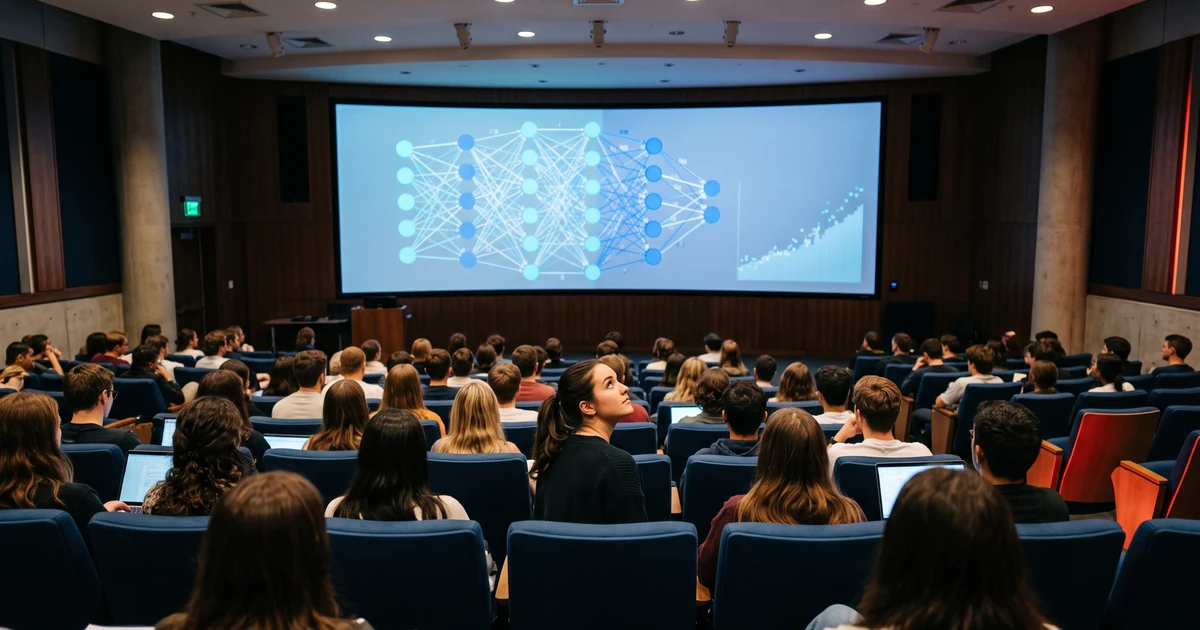
Do colleges offer AI degrees? Yes, and the list keeps growing every semester as employers scramble to fill roles that did not exist five years ago.
TL;DR: Yes, U.S. colleges offer AI degrees, and the count keeps growing fast. Over two dozen universities award bachelor’s degrees in artificial intelligence today, including Carnegie Mellon, Purdue, Penn, Arizona State, Georgia Tech, and Johns Hopkins. Syracuse, the University of Idaho, and the University of Maryland all announced brand-new AI degree programs for 2026-2027 launch. The driver: AI-related job postings jumped 144% year over year per Syracuse’s College of Engineering. This guide covers the current program list, curriculum, online options, salary outcomes, and why pairing an AI degree with cybersecurity training doubles your hiring pool.
Jump to a section:
- Do colleges offer AI degrees in 2026?
- Why are universities launching AI degrees right now?
- Which colleges offer AI bachelor’s degrees today?
- Which new AI degree programs launch in 2026 and 2027?
- What do you study in an AI degree program?
- Are there online AI degree programs?
- How does an AI degree compare to a computer science degree?
- Should you pair an AI degree with cybersecurity training?
- What jobs do AI graduates land after college?
- How much do AI degree holders earn?
- Frequently asked questions
Five years ago, if a high school senior asked whether they should major in “artificial intelligence,” the answer was mostly no. AI was a concentration inside a computer science degree, not a standalone major. That changed fast. Employer demand outran university curricula, and department chairs across the country responded by launching dedicated AI bachelor’s programs, some of them in under 18 months from proposal to first cohort.
The result is a fast-moving map of AI degree options. Some are decade-old flagship programs. Others are launching for the fall 2026 semester. This guide covers the current state, the new arrivals, what you learn, what it costs you, and how to plan the degree so you graduate hireable.
Do colleges offer AI degrees in 2026?
Direct answer: Yes. As of 2026, more than two dozen U.S. universities offer a bachelor’s degree in artificial intelligence, and more schools add programs every semester. Master’s and PhD options are even broader.
The short version is that “yes, colleges offer AI degrees” is now a boring answer. The interesting question is which one to pick, and why.
Carnegie Mellon launched the first standalone B.S. in Artificial Intelligence in the U.S. back in 2018. For a few years it was almost alone at the bachelor’s level. Since 2022, the field has widened sharply. CNBC counted 14 U.S. colleges offering an AI bachelor’s degree as of early 2025, and the tally passed 25 by mid-2026 as regional public universities and private schools added their own programs.
At the master’s level, the count is bigger still. Nearly every research university with a computer science department now offers an M.S. in AI, machine learning, or a hyphenated variant like data science and AI. Online options at the master’s level are growing quickly too, which matters for working professionals who want to switch tracks without stepping away from their current job.
Why are universities launching AI degrees right now?
Direct answer: Employer demand. AI-related job postings grew 144% year over year, and starting salaries for AI roles now sit well above computer science averages. Universities are chasing the fastest-growing skill gap in tech.
Syracuse University’s College of Engineering pointed to that 144% figure when it announced its new AI Science bachelor’s and master’s degrees for fall 2026. The stat came from Lightcast job-posting data referenced in the Syracuse ECS launch announcement. One year, one skill category, more than doubled.
The demand cuts across sectors. Finance firms want quants who understand transformer architectures. Hospitals want clinical decision-support engineers. Defense contractors want ML systems architects with security clearances. Retailers want personalization engineers. None of these employers has time to wait for a general computer science graduate to teach themselves PyTorch on the job.
Universities also feel pressure from the demand side of their own funnel. High schoolers who watched ChatGPT go mainstream in 2023 want a degree name that says AI. A B.S. in Computer Science with an unofficial AI concentration does not compete for that student against a B.S. in Artificial Intelligence at the school across the state. Enrollment numbers force department chairs to move.
The pattern is not unique to AI. We wrote about how AI is fueling a parallel cybersecurity hiring boom, and the same forces are pulling students toward security programs. The two fields are converging on the same graduates from opposite directions.
Which colleges offer AI bachelor’s degrees today?
Direct answer: Over 25 U.S. universities offer an AI bachelor’s degree in 2026. The best-known programs are at Carnegie Mellon, Purdue, Penn, Georgia Tech, Johns Hopkins, Arizona State, Illinois Tech, and Indiana University. New public and private options open every year.
Here is a working list of U.S. colleges with dedicated AI bachelor’s programs (or a close AI-focused degree) as of mid-2026. It is not exhaustive, and program names shift as departments reshape offerings.
| University | Program name | Location | Modality |
|---|---|---|---|
| Carnegie Mellon University | B.S. in Artificial Intelligence | Pittsburgh, PA | On-campus |
| Purdue University | B.S. in Artificial Intelligence | West Lafayette, IN | On-campus |
| University of Pennsylvania | B.S.E. in Artificial Intelligence | Philadelphia, PA | On-campus |
| Georgia Institute of Technology | B.S. Computer Science, Intelligence thread | Atlanta, GA | On-campus |
| Johns Hopkins University | B.S. Applied Math, AI/ML focus | Baltimore, MD | On-campus |
| Arizona State University | B.S. in Applied AI | Tempe, AZ | On-campus + online |
| University of Texas at San Antonio | B.S. in Artificial Intelligence | San Antonio, TX | On-campus |
| Illinois Institute of Technology | B.S. in Artificial Intelligence | Chicago, IL | On-campus |
| Indiana University | B.S. in Intelligent Systems Engineering | Bloomington, IN | On-campus |
| Boise State University | B.S. in Artificial Intelligence | Boise, ID | On-campus |
| Northeastern University | B.S. in Data Science + AI concentration | Boston, MA | On-campus + co-op |
| Maryville University | B.S. in Artificial Intelligence | St. Louis, MO | Online + on-campus |
| Drexel University | B.S. in Computer Science, AI concentration | Philadelphia, PA | On-campus + co-op |
| Illinois Wesleyan | B.S. in Artificial Intelligence | Bloomington, IL | On-campus |
For a longer, ranked view with tuition detail and program length, the learn.org roundup of the best online AI degree programs covers the market in depth. If you want the more selective public-school shortlist, Lantern College Counseling’s AI undergraduate major guide is worth a read.
The takeaway: the market has moved from “a few flagship programs” to “a real menu.” Location, cost, and modality now matter as much as school prestige.
Which new AI degree programs launch in 2026 and 2027?
Direct answer: Syracuse launches an AI Science B.S. and M.S. in fall 2026. The University of Idaho adds an AI bachelor’s, M.S., and M.Eng. in fall 2026. The University of Maryland opens two undergraduate AI degrees by fall 2027, one technical and one human-centered.
Three high-signal launches worth watching this cycle:
Syracuse University (fall 2026)
Syracuse’s College of Engineering and Computer Science will offer a Bachelor of Science and a Master of Science in Artificial Intelligence Science starting fall 2026. The programs are among the first at the undergraduate level to offer both software and hardware concentrations. The hardware track covers FPGA acceleration, neuromorphic chip design, and systolic array architectures for deep neural network processing. Syracuse pointed to the 144% year-over-year growth in AI job postings as the main driver, per the Syracuse ECS launch announcement.
The hardware concentration is unusual at the bachelor’s level. Most AI degrees at other schools focus purely on software (PyTorch, TensorFlow, model training). Syracuse is betting on graduates who understand the silicon their models run on, a skill set that pays well at NVIDIA, Google TPU teams, and defense contractors.
University of Idaho (fall 2026)
The University of Idaho announced three new AI degrees for fall 2026: a bachelor’s, an M.S., and an M.Eng. The undergrad program runs at the Moscow and Coeur d’Alene campuses, and the master’s programs are fully online. The announcement, covered in Idaho Ed News, means all three of Idaho’s four-year public universities will offer AI degrees in the 2026-2027 academic year. Boise State launched the state’s first AI bachelor’s in 2025, and Idaho State followed.
For students in the Pacific Northwest and Mountain West, this is a big deal. It is one of the first states where every public university option now includes AI as a first-class degree.
University of Maryland (fall 2027)
The University of Maryland announced two new undergraduate AI degrees launching by fall 2027. The Bachelor of Arts in Human-Centered AI, housed in the College of Arts and Humanities, emphasizes ethics, public policy, and philosophy, with seven specializations ranging from law and governance to design and user experience. The Bachelor of Science in AI is offered through the Department of Computer Science and focuses on building AI systems and algorithms from the ground up. The full launch is covered on the University of Maryland’s AIM site.
The B.A. is worth calling out. Most AI bachelor’s degrees are heavy on math and coding and light on the “so what should we do with this technology” question. Maryland’s B.A. flips the ratio, and that is a rare offering. Students who want to work in AI policy, AI product management, or applied ethics finally have a degree that maps to the job.
What do you study in an AI degree program?
Direct answer: Core courses cover linear algebra, calculus, statistics, Python programming, machine learning, deep learning, and neural network architecture. Upper-level courses branch into computer vision, natural language processing, reinforcement learning, and AI ethics.
An AI bachelor’s degree looks a lot like a math-heavy computer science degree, with the second half of the curriculum replacing broad CS electives with AI-specific coursework. Expect roughly this shape:
First two years (foundations):
- Calculus I, II, III
- Linear algebra
- Discrete mathematics
- Probability and statistics
- Introductory programming (usually Python)
- Data structures and algorithms
Second two years (AI core):
- Machine learning fundamentals
- Deep learning and neural networks
- Computer vision
- Natural language processing
- Reinforcement learning
- Optimization theory
- AI ethics and safety
- Capstone project (a real ML system deployed end to end)
Some programs add a systems layer: distributed computing, GPU programming, MLOps, or the hardware acceleration Syracuse is building around. Others push the math further into optimization, information theory, and Bayesian inference.
The workload is heavy. A typical AI major runs more math than a typical CS major, and the ML frameworks change so often that self-directed learning is part of the deal. Students who thrive in these programs tend to arrive with strong high-school math and a willingness to spend weekends on side projects.
Are there online AI degree programs?
Direct answer: Yes, though the online undergrad options are still limited compared to computer science. Arizona State, Maryville, and a handful of regional schools offer fully online AI bachelor’s tracks. Master’s-level online AI programs are much more common.
At the bachelor’s level, Arizona State University’s B.S. in Applied Artificial Intelligence runs a fully online track through ASU Online, with the same curriculum as the on-campus version. Maryville University in St. Louis offers an online AI bachelor’s aimed at working adults. A few smaller schools offer AI concentrations inside an online computer science degree.
For master’s, the menu is broad. Georgia Tech’s online M.S. in Computer Science with an ML specialization is one of the most respected options in the country, and it costs a fraction of the on-campus version. The University of Idaho’s new M.S. and M.Eng. in AI (launching fall 2026) are fully online. Johns Hopkins, Stanford, and Purdue all run online AI or ML master’s programs.
Before enrolling online, check three things:
- Accreditation. The program should sit inside a regionally accredited university. Look for the accreditation body (Higher Learning Commission, WASC, Middle States, etc.) on the university’s website.
- Hands-on labs. ML is not a spectator sport. If the program has no coding-heavy capstone or lab component, employers will discount the credential.
- Career services access. Some online programs offer the same career support as on-campus. Others treat online students as afterthoughts. Ask before you commit.
How does an AI degree compare to a computer science degree?
Direct answer: An AI degree specializes early and pays off for students who know they want ML, data science, or AI research. A CS degree stays broader and preserves more career paths. Both open the door to strong salaries in 2026, but only one narrows your options.
Here is the side-by-side that matters for the choice:
| Dimension | AI Degree | Computer Science Degree |
|---|---|---|
| Focus | Machine learning, neural networks, model building | Software, systems, algorithms, security, networks |
| Math load | Heavy: linear algebra, calculus, statistics, optimization | Moderate: discrete math, calculus |
| Coding load | Python-first, ML framework fluency | Multi-language, full stack |
| Career fit | Data scientist, ML engineer, AI researcher | Software engineer, DevOps, backend, security |
| Flexibility | Narrower, specialization-heavy | Broader, more career paths |
| Grad school prep | Strong for AI/ML masters, weaker for other CS tracks | Strong for any CS graduate program |
| Employer recognition | Rising fast, still less universal than CS | Universal, decades of hiring pipelines |
| Best fit for | Students certain about AI/ML career track | Students who want optionality |
A working heuristic: if you are already contributing to open-source ML projects in high school and know you want to be an ML engineer, an AI degree gets you there faster. If you are still figuring out what corner of tech you want, a CS degree with an AI concentration keeps every door open.
One more angle. AI programs are still new enough that their alumni networks are thin. A CS graduate from Purdue in 2010 has 15 years of alumni running hiring teams at every major employer. An AI graduate from Purdue in 2028 will not have that network for another decade. Alumni networks matter for the first two jobs after graduation, and the AI-degree cohort has to build theirs from scratch.
Should you pair an AI degree with cybersecurity training?
Direct answer: Yes, if you want the highest-paying and most-in-demand job categories. Adversarial ML, prompt injection defense, model supply-chain security, and AI-generated phishing response are all unfilled roles that reward candidates with both skill sets.
The AI graduates who get hired fastest right now are the ones who show up with security fundamentals on top of their ML skills. There is a reason for that. Every large enterprise deploying LLMs is finding out the hard way that AI systems introduce a new attack surface no one on their security team is trained to defend.
Concrete examples of the overlap:
- Prompt injection. An LLM-powered customer service bot exposed to untrusted input is a data-exfiltration vector. The engineer who trains it should understand OWASP LLM Top 10, threat modeling, and secure prompt design.
- Model supply chain. Public model weights from Hugging Face have been backdoored more than once. Anyone downloading and fine-tuning a model needs software composition analysis instincts.
- Adversarial ML. Classifiers get fooled by carefully crafted inputs. Vision systems get bypassed by adversarial patches. Fraud models get evaded by adaptive attackers. Defending them is a real engineering discipline.
- AI-generated phishing. Voice-clone fraud is now a routine BEC pattern. Detection tooling has to catch what LLMs generate, not what humans wrote a decade ago.
If your AI program does not offer a security elective, take one from the CS or information systems department. Read the OWASP Top 10 for LLM Applications. Build a home lab where you attack and defend an LLM you deployed yourself. That combined skill set puts you ahead of 95% of AI graduates on the job market.
The pay premium is real. Job postings for “AI security engineer” and “ML security engineer” now run 15% to 25% above pure ML engineer roles, and the pool of qualified candidates is small. If you want a longer read on the career logic behind the AI + security combo, our cybersecurity career guide walks through the full picture, including certifications and the current hiring market.
What jobs do AI graduates land after college?
Direct answer: Machine learning engineer, data scientist, AI research engineer, MLOps engineer, AI product manager, and AI security engineer are the six most common landing spots. Most pay six figures on day one at mid-to-large employers.
Here is the shape of the AI job market for a recent bachelor’s grad in 2026:
| Role | Typical work | Median U.S. salary (2026) | Cybersecurity overlap |
|---|---|---|---|
| Machine Learning Engineer | Build, train, deploy ML models in production | ~$145,000 | Adversarial ML, secure model deployment |
| Data Scientist | Statistical analysis, model prototyping, business insight | ~$120,000 | Threat detection, anomaly analysis |
| AI Research Engineer | Push model capability, publish, build novel architectures | ~$170,000 | Model robustness, LLM red-teaming |
| MLOps Engineer | Model deployment pipelines, monitoring, drift detection | ~$140,000 | Model supply chain, artifact signing |
| AI Product Manager | Own AI product line, define metrics, coordinate engineering | ~$150,000 | AI risk assessment, governance |
| AI Security Engineer | Defend AI systems and use AI for defense | ~$160,000 | Direct overlap |
Salary ranges pull from Levels.fyi, Glassdoor, and Bureau of Labor Statistics data on computer and information research scientists, the closest official BLS category. Actual offers vary sharply by geography, employer size, and whether the role involves publication or leadership responsibility.
Where do these hires end up? Big tech (Google, Meta, Amazon, Microsoft, NVIDIA) still absorbs the largest share of top-tier AI grads. Finance (Two Sigma, Citadel, Jane Street) pays the highest starting salaries for research-track engineers. Defense and intel (Palantir, Anduril, defense primes) hire heavily for AI systems work, especially candidates who can get a clearance. Healthcare, autonomous vehicles, retail, and manufacturing all round out the picture, and every one of them has an unfilled AI security requisition on the board somewhere.
How much do AI degree holders earn?
Direct answer: Entry-level AI engineer roles at large tech employers start between $130,000 and $180,000 total compensation. Mid-career (5 to 8 years) commonly reaches $250,000 to $400,000 at big tech. Research scientists at frontier AI labs push past $500,000 base plus equity.
Two things drive the pay bands. First, demand for AI talent is outrunning supply for the second straight year, which pushes offers up. Second, frontier AI labs (OpenAI, Anthropic, Google DeepMind, xAI) are competing for a small pool of top researchers, which pulls the ceiling higher and drags market rates up beneath it.
For a new bachelor’s grad, the realistic range depends on where you land:
- Large tech employer (FAANG-tier): $130,000 to $180,000 total comp
- Mid-size tech or well-funded startup: $110,000 to $160,000 total comp
- Traditional enterprise (bank, retailer, healthcare): $95,000 to $135,000 total comp
- Government or defense contractor: $85,000 to $125,000 base, plus clearance bonus if applicable
- Non-profit or academic research role: $70,000 to $95,000
Master’s holders start higher, typically 10% to 20% above bachelor’s offers at the same employer. PhDs enter at senior-engineer or research-scientist bands, which cross $200,000 base at big tech.
The one caveat: these numbers assume you can pass the interview. Modern AI interviews test ML fundamentals, coding, system design, and increasingly a hands-on “build me a small model and explain your choices” segment. Your degree opens the door. The portfolio you built during it wins the offer.
The bottom line for prospective AI students
Colleges offer AI degrees, and the answer to “which one is right for me” now depends more on cost, location, and program specialty than on whether the option exists.
If you are certain about an ML engineering or AI research path, a dedicated AI bachelor’s from Carnegie Mellon, Purdue, Penn, Georgia Tech, or one of the new Syracuse and Idaho programs is a strong direct route. If you want optionality, a computer science degree with a heavy AI concentration keeps the door open to software, cybersecurity, and DevOps. If you want to work at the intersection of AI policy and product, the University of Maryland’s new B.A. in Human-Centered AI is worth serious consideration.
Whichever program you pick, three moves pay off:
- Build in public. Push code to GitHub. Publish write-ups. AI hiring managers hire evidence, not transcripts.
- Add security. Take a security elective. Read OWASP’s LLM Top 10. Learn to threat-model an ML pipeline. It doubles your hiring options.
- Talk to humans. Cold-apply into ATS portals loses to a 15-minute intro call with someone on the team you want to join. Every semester of undergrad is a chance to build that network.
The AI degree market is moving fast. The graduates who move faster than it does will own the next hiring cycle.
Frequently asked questions
Do colleges offer AI degrees at the bachelor’s level?
Yes. As of 2026, more than two dozen U.S. universities award a Bachelor of Science in Artificial Intelligence or a closely related AI degree. Early movers include Carnegie Mellon, Purdue, Penn, Georgia Tech, Johns Hopkins, Arizona State, and Boise State. Syracuse and the University of Idaho add new programs in fall 2026, and the University of Maryland opens two AI bachelor’s degrees by fall 2027.
Can you get an AI degree online?
Yes. Arizona State University offers a fully online B.S. in Applied AI, Maryville University runs an online AI bachelor’s, and the University of Idaho’s new master’s programs are online. For undergrad, the online options are still limited compared to computer science, so check accreditation and whether the program includes hands-on ML lab work before enrolling.
How long does it take to earn an AI degree?
A bachelor’s in AI takes four years full time at most U.S. universities. Master’s programs run one to two years. Some accelerated 4+1 programs at schools like Purdue and Northeastern let you finish both degrees in five years. Community-college transfer paths shorten the on-campus time to two years for eligible students.
Is an AI degree worth it in 2026?
For students who want a direct path into ML engineering, AI research, or applied data science, yes. AI-related job postings jumped 144% year over year per Syracuse’s College of Engineering, and starting salaries for ML engineers sit above $130,000 at mid-to-large employers. A broad computer science degree still offers more career flexibility if you are undecided.
Do you need cybersecurity training if you study AI?
Yes, if you want to be hired quickly. Adversarial machine learning, prompt injection, model supply-chain attacks, and AI-generated phishing are core enterprise concerns. AI graduates who add security fundamentals (network basics, threat modeling, secure coding) qualify for AI security engineer roles most employers struggle to fill.
Which university has the best AI program?
By research output and hiring reputation, Carnegie Mellon, Stanford, MIT, and Georgia Tech lead. For accessible AI bachelor’s programs with strong industry ties, Purdue, Arizona State, and Northeastern rank highly. The best program for you depends on cost, location, online availability, and whether you want a research track or an applied-AI track.