Ring Backtracks: Super Bowl Ad Sparks Privacy Pushback

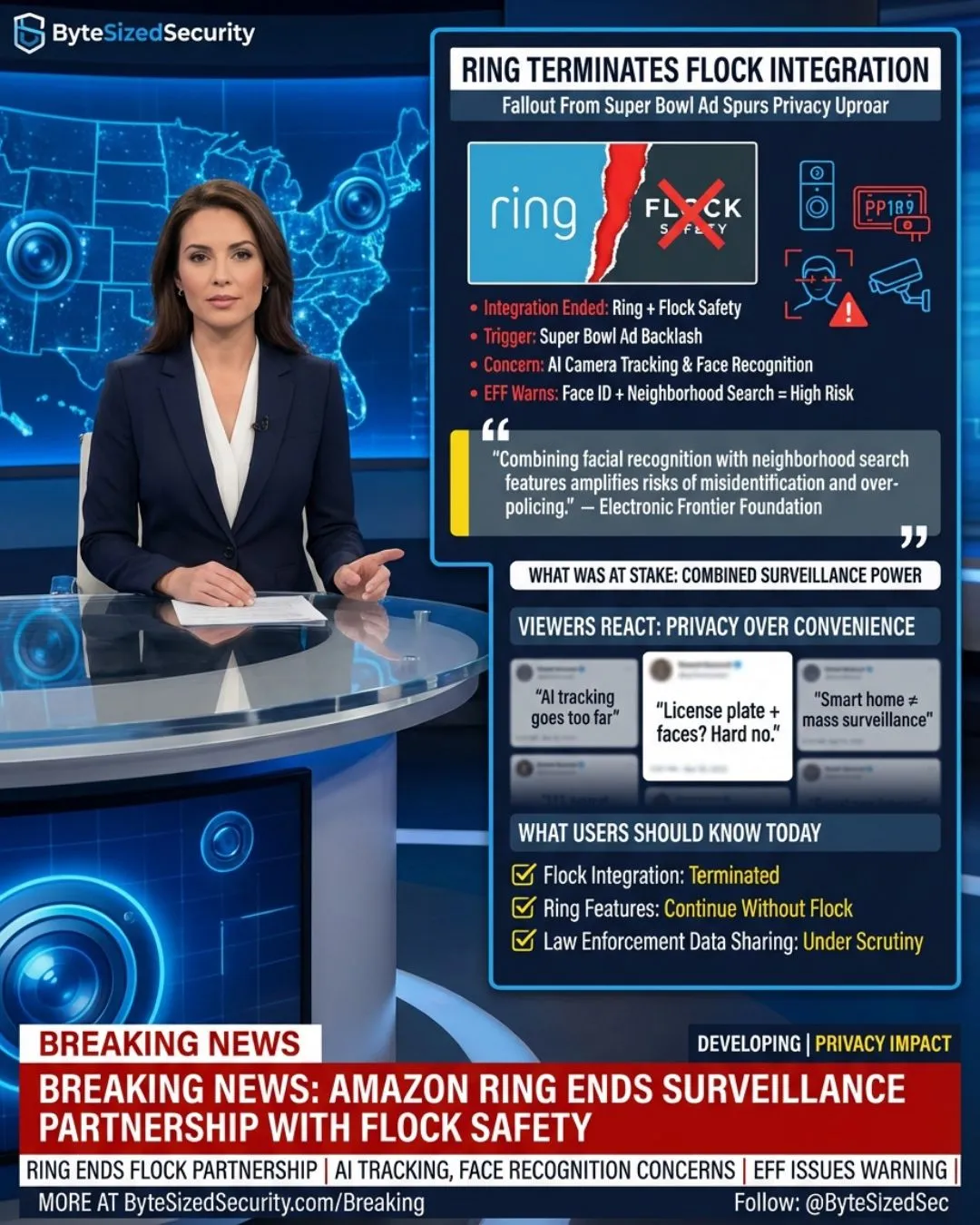
Title: Amazon Ring Ends Surveillance Partnership After Super Bowl Ad Backlash … Here’s What It Means for Your Privacy
TL;DR: Amazon’s Ring doorbell division scrapped a planned integration with police surveillance company Flock Safety after a Super Bowl ad depicting AI-powered neighborhood camera tracking sparked widespread public outrage. While Amazon cites “time and resources” as the official reason, the timing tells a bigger story about growing consumer resistance to surveillance technology … and why it matters for everyday privacy.
A Super Bowl Ad That Spooked America
Super Bowl ads are supposed to sell you on a product. Amazon Ring’s 30-second spot tried to do exactly that … showing a lost dog found through a neighborhood network of cameras using artificial intelligence. Heartwarming on the surface, right?
Not everyone saw it that way.
Viewers took to social media almost immediately, calling the ad “sinister” and “dystopian.” The concern wasn’t really about finding lost dogs … it was about what else that kind of camera network could track. Specifically, people.
And honestly? That concern isn’t unfounded.
What Was the Ring-Flock Safety Partnership?
To understand the backlash, you need to know what was happening behind the scenes.
Ring and Flock Safety announced a partnership last year that would have allowed Ring doorbell owners to share their video footage with law enforcement through a feature called “Community Requests.” Flock Safety is one of the largest operators of automated license-plate reading (ALPR) systems in the United States … its cameras are mounted in thousands of communities, capturing billions of license plate photos every single month.
The planned integration would have essentially connected your Ring doorbell footage to a broader surveillance infrastructure used by police departments across the country.
Following the Super Bowl backlash, Ring announced the partnership was being terminated. Their official statement cited the integration requiring “significantly more time and resources than anticipated.” They also confirmed the integration never actually launched … meaning no Ring customer videos were ever sent to Flock Safety.
But let’s be clear: the timing of this announcement, coming right after a wave of public outrage, speaks volumes.
Why This Matters Beyond the Ad
This story isn’t just about one commercial or one partnership. It sits at the intersection of several major privacy concerns that affect all of us:
… The expanding reach of home surveillance: Ring doorbells are in millions of American homes. When those cameras can be networked together and shared with law enforcement … often without neighbors’ knowledge … the privacy implications are enormous.
… AI-powered tracking is already here: Ring’s “Search Party” feature uses artificial intelligence to track objects (and potentially people) across a network of neighborhood cameras. Their “Familiar Faces” feature already uses facial recognition to scan and identify people who pass by your door.
… The law enforcement connection: The Electronic Frontier Foundation (EFF) warned this week that combining Ring’s facial recognition capabilities with its neighborhood search features could create a powerful surveillance tool. It doesn’t take much imagination to see where that combination leads.
… Immigration enforcement concerns: Flock Safety has also faced scrutiny amid the current immigration enforcement climate. While Flock maintains it doesn’t partner directly with ICE, they’ve acknowledged that police departments using their cameras can choose to share data with federal agencies … and Flock “has no ability to override that decision.”
What Can You Actually Do?
If you own a Ring doorbell (or any smart home camera), here are some practical steps:
… Review your sharing settings. Check whether features like Community Requests or video sharing with law enforcement are enabled … and decide whether you’re comfortable with that.
… Understand what “Familiar Faces” does. If you have this feature enabled, your camera is scanning and storing biometric data of everyone who walks past. That includes your neighbors, delivery drivers, and anyone else in range.
… Know your rights. In many jurisdictions, you have the right to know when your data is being shared with law enforcement. Familiarize yourself with your local laws around surveillance and data sharing.
… Vote with your wallet … and your voice. This story proves that consumer backlash works. Amazon scrapped a major surveillance partnership because people spoke up. Democratic Senator Edward Markey has already urged Amazon to discontinue its “Familiar Faces” technology based on this public opposition.
The Bigger Picture
Here’s what this moment really shows us: the line between “smart home convenience” and “mass surveillance infrastructure” is thinner than most people realize.
When your doorbell camera can be networked with every other camera on your street, analyzed by AI, cross-referenced with facial recognition databases, and shared with law enforcement … that’s not a smart home feature anymore. That’s a surveillance system you installed yourself.
The good news? Public pressure still matters. Amazon’s decision to scrap this partnership proves that companies respond when consumers push back on privacy overreach. The more we understand what these technologies actually do … not just what the ads tell us they do … the better equipped we are to set boundaries.
Your smart home should work for you, not watch you.
For more on protecting your privacy, see our practical guide on small steps that make a big impact on your digital footprint. And if you’re concerned about how companies monetize your data, read about what LinkedIn’s verification badge actually costs you in terms of biometric data.
Source: SecurityWeek … Amazon Scraps Partnership With Surveillance Company After Super Bowl Ad Backlash (https://www.securityweek.com/amazon-scraps-partnership-with-surveillance-company-after-super-bowl-ad-backlash/)