iRhythm Data Breach: 12 Million Patient Records Exposed

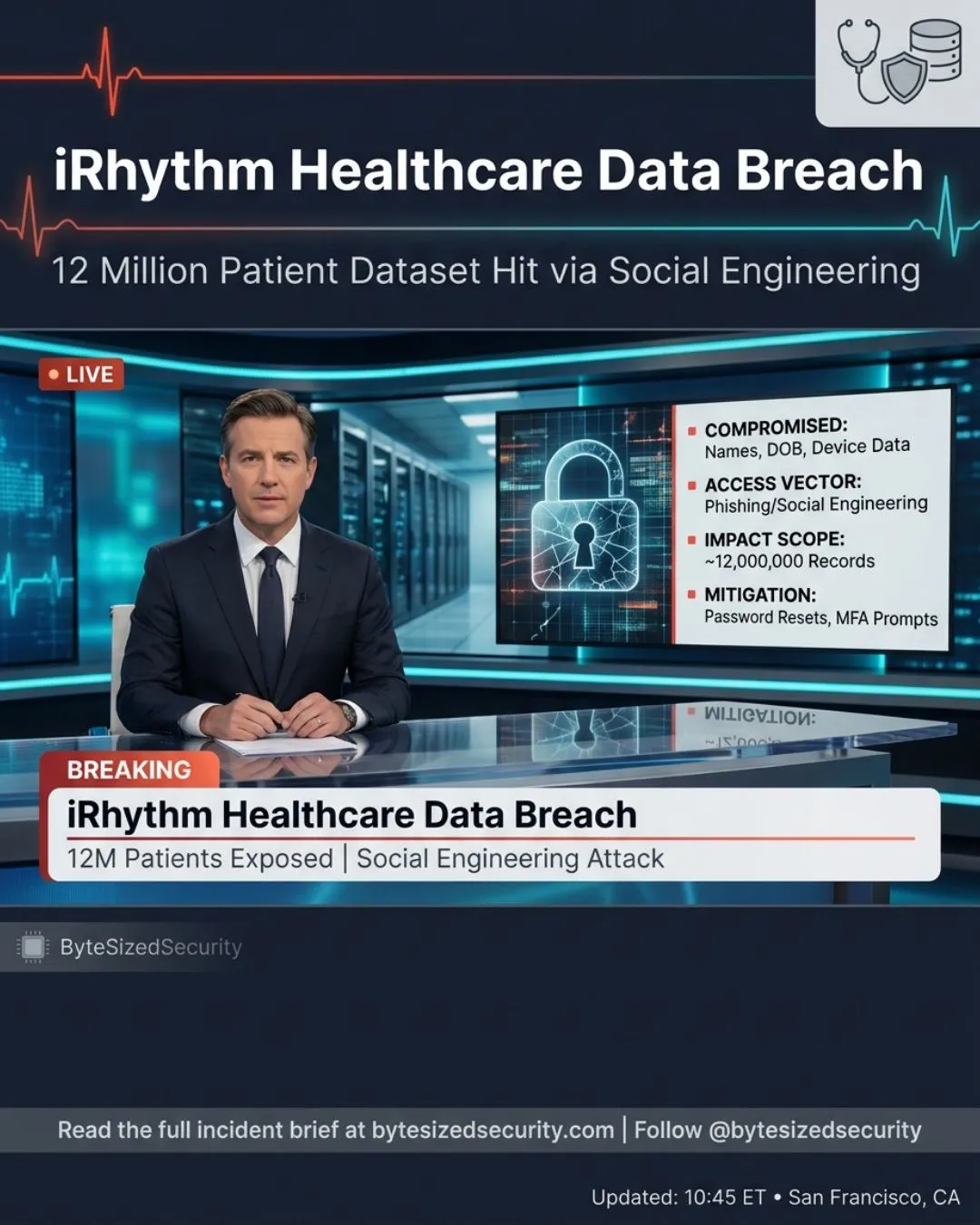
iRhythm Healthcare Data Breach: 12 Million Patient Dataset Hit via Social Engineering of Third-Party Apps
TL;DR
- Who: iRhythm Holdings (NASDAQ: IRTC), the digital healthcare company behind the Zio cardiac monitoring patch.
- What: Patient protected health information (PHI) and proprietary data exfiltrated from third-party-hosted business applications.
- How: Social engineering of personnel to gain access to those third-party apps.
- When: Ransom communication received June 9, 2026. Materiality determined June 10. SEC 8-K filed Monday, June 15, per BleepingComputer’s reporting.
- Scale context: iRhythm’s platform has analyzed over 2 billion hours of curated heartbeat data from more than 12 million patients. The exact count of affected individuals has not been disclosed.
- What’s safe: No payment or financial account data (not stored). No reported impact on clinical or medical device systems, patient safety, manufacturing, or financial reporting.
What we know
iRhythm Holdings disclosed the breach in a Form 8-K filing with the U.S. Securities and Exchange Commission on Monday, June 15, 2026. The disclosure became public via BleepingComputer’s reporting on the filing.
Per the filing summary:
- On June 9, 2026, iRhythm received an extortion communication from a threat actor claiming possession of proprietary data, patient PHI, and other personal information, and demanding payment in exchange for non-disclosure.
- iRhythm subsequently confirmed data exfiltration from third-party-hosted business applications.
- On June 10, the company determined the incident was material, kicking off the SEC’s 4-business-day filing clock under the cybersecurity incident disclosure rule adopted in 2023.
- The threat actor reached the data through social engineering of iRhythm personnel.
- The threat actor has not been attributed to a specific extortion crew.
- No payment card or financial account information was exposed (iRhythm does not store this data).
- No impact has been reported on iRhythm’s clinical or medical device systems, patient safety, manufacturing and distribution operations, or financial reporting systems.
Why this matters
iRhythm operates the Zio, a wearable continuous-ECG monitoring patch. Cardiologists rely on it for ambulatory rhythm monitoring (catching things like atrial fibrillation, heart blocks, and other arrhythmias). The company reports its platform has processed more than 2 billion hours of heartbeat data from over 12 million patients since inception.
The dataset is among the largest curated heart-rhythm corpuses in healthcare. While the exact count of affected individuals has not been published, the breach’s potential reach is meaningful both for affected patients (HIPAA notifications under the Breach Notification Rule will follow) and for iRhythm’s clinical research pipeline if proprietary data was exfiltrated.
The bigger story is the initial access vector. Per iRhythm’s own filing, attackers used social engineering to reach third-party-hosted business apps holding patient data. Not a zero-day. Not an unpatched VPN. People tricked into approving access or surrendering credentials.
This matches the dominant healthcare-breach pattern of 2026:
- Change Healthcare (Feb 2024): ALPHV/BlackCat used social engineering against the Citrix help desk
- MGM Resorts (Sep 2023): Scattered Spider tricked the help desk into resetting MFA
- Marks & Spencer (Apr 2025): Scattered Spider-style social engineering against IT
- Novo Nordisk (last week): clinical-trials data stolen, also from internal IT systems
Defense against social engineering is mostly process and architecture, not antivirus.
What healthcare security teams should do this week
-
Inventory every third-party SaaS app with PHI access. Not the EHR. The long tail: billing portals, prior-authorization tools, patient-engagement platforms, clinical-trial vendors, analytics tools, marketing automation with patient lists. Apply HIPAA’s Breach Notification Rule scope rigorously. Every Business Associate counts.
-
Phishing-resistant MFA on everything touching patient data. SMS and TOTP push are not enough. Move to FIDO2 / WebAuthn (or platform passkeys) per NIST SP 800-63B AAL2/AAL3 guidance. Apply it to your SSO front door and to the back-end admin consoles of every SaaS app with regulated data access.
-
Help-desk caller-verification procedures. Social-engineering reset attacks defeat the strongest MFA because they bypass it entirely. Require out-of-band verification (manager callback, badge-on-camera, second-channel video) before resetting credentials or registering new MFA devices.
-
SaaS PHI exposure logging. Centralize audit logs from every PHI-bearing SaaS app into one SIEM or log lake. Detecting anomalous downloads from a third-party app requires ingesting its logs in the first place.
-
Incident response playbook with an SEC materiality clock. If you’re a public company, your IR runbook needs a parallel track for the SEC’s 4-business-day Item 1.05 8-K disclosure timeline. iRhythm hit theirs cleanly: ransom communication June 9 → materiality decision June 10 → 8-K filing June 15. Practice this clock in tabletops, not in real incidents.
The bigger picture
Healthcare data is a uniquely valuable target. Unlike a stolen credit card (cancellable in 24 hours), stolen PHI is permanent: diagnoses, medications, providers, and billing identifiers persist for life and feed downstream fraud (medical identity theft, insurance fraud, targeted phishing).
The HHS Office for Civil Rights publishes ongoing reports on healthcare breaches affecting 500+ individuals on its Breach Notification Portal (informally known as the “Wall of Shame”). Expect iRhythm to appear there within the 60-day HIPAA notification window once the affected individual count is finalized.
For patients with a Zio device or recent ambulatory rhythm monitoring: there is no immediate action to take. iRhythm has not yet identified which individuals were affected. Watch for direct notification from iRhythm or your cardiology practice over the coming weeks.