Credential Theft: The New Normal in Cyber Attacks

Your Next Breach Won’t Look Like an Attack. It’ll Look Like a Normal Tuesday.
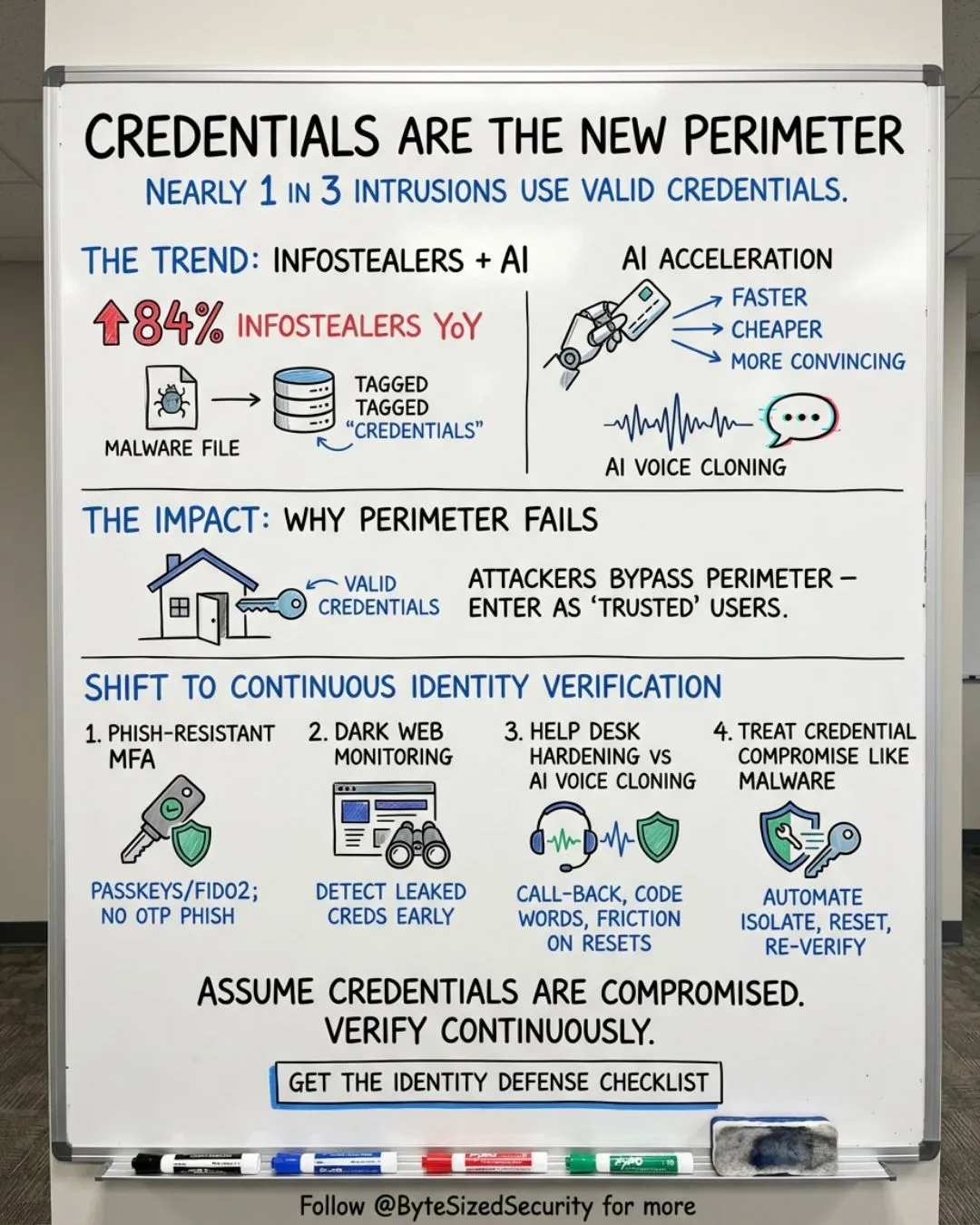
TL;DR: Nearly one in three cyber intrusions now use valid employee credentials. Infostealers are up 84% year-over-year. AI has made credential theft faster, cheaper, and harder to detect. If your security model still treats authentication as a one-time gate, you’re leaving the front door open. Here’s what needs to change.
The Problem
Your firewalls are tight. Your SOC is watching for zero-days. Your perimeter is hardened. And none of it matters when the attacker logs in with a real employee ID.
Nearly one in three cyber intrusions now involve valid employee credentials. Not exploits. Not zero-days. Legitimate logins.
Credential theft isn’t new. What’s changed is the economics. AI has stripped away the barriers to entry. Phishing campaigns that once required real technical skill now get generated at volume in minutes. Stolen credentials get tested and deployed across platforms automatically. The attacker doesn’t need to be sophisticated anymore. They need a subscription to the right underground marketplace.
The Credential Theft Economy
The credential-theft ecosystem has professionalized to a degree most defenders don’t fully recognize. Threat actors have built entire business models around finding, validating, and reselling stolen credentials. Buyers include financially motivated criminals, ransomware operators, and nation-state actors who purchase access from Dark Web forums to launch intrusion campaigns that look like ordinary cybercrime.
This collaboration is what security teams consistently underestimate. Attackers share scripts, sell access to each other, and maximize profit with minimal risk. Meanwhile, defenders are siloed by private vendor frameworks and a lingering culture of victim-blaming. Attackers operate like a coordinated enterprise. Defenders often operate in isolation.
The supply chain makes this worse. A single set of credentials in an interconnected ecosystem acts as a master key. Attackers understand this network effect. They’re exploiting it systematically.
AI Changed the Math
Information-stealing malware (the primary way credentials get stolen) has surged 84% over the last year. We covered how infostealers now reconstruct entire identities from a single infection — the problem is no longer just stolen passwords. On the supply side, the pipeline is flooding.
On the deployment side, AI has removed the technical skill requirement entirely. In the past, launching a credential-based attack at scale required custom scripts, the ability to move through a network undetected, and the tradecraft to blend into normal traffic patterns.
Now, AI tools let an attacker take a file of stolen credentials and automate deployment across platforms instantly. Once inside, AI-assisted tooling generates convincing behavioral patterns, mimics normal user activity, and helps attackers move through a network in ways that look indistinguishable from legitimate operations. Whether it’s a mass spraying attack or a targeted intrusion, the velocity now exceeds what traditional defenses were built to handle.
What Needs to Change
The core problem: if an attacker is authenticated with real credentials and operating during business hours, traditional alarms stay silent. The detection model itself needs to shift.
- Move identity monitoring upstream
Dark Web and underground forum monitoring needs to feed directly into active response workflows, not monthly reports. The moment a credential match surfaces externally, it should trigger automated credential rotation and mandatory MFA before it reaches your production environment.
- Deploy phish-resistant MFA
Traditional SMS or push-based MFA no longer stops modern adversary-in-the-middle attacks. Move toward FIDO2-compliant hardware keys or certificate-based authentication. If the “something you have” gets intercepted by a proxy, it’s no longer a secure second factor. If your organization hasn’t deployed MFA yet, start with our 2FA implementation guide — it blocks over 99% of automated attacks.
- Treat authentication as continuous
Stop treating login as a one-time gate where a user is trusted indefinitely after one MFA prompt. Adopt Continuous Adaptive Trust models that re-evaluate risk in real-time based on behavioral signals: sudden changes in typing cadence, unusual file access, impossible travel logins.
- Harden the help desk against AI social engineering
AI-generated voice cloning has made the “forgot my password” call a massive vulnerability. Establish out-of-band verification processes: require a video call with a known supervisor or a physical token before processing credential reset requests.
- Audit identity sprawl
Inventory third-party integrations and service accounts. These often rely on static credentials that bypass MFA and rarely get rotated. Enforce least privilege. Every service account needs a defined expiration date and a designated human owner.
- Treat credential compromise like a malware detection
When a compromised credential surfaces, the response needs to be immediate and holistic. Not “change the password.” Instead: “What did this identity access in the 48 hours before the alert?” A valid login alert deserves the same urgency as a malware detection.
The Bottom Line
The shift to credential-based attacks is strategic. It’s low risk for the attacker, highly automated, and effective at bypassing hardened perimeters. Identity is no longer a static gate. It’s a continuous, high-priority signal.
If your detection model still trusts a session indefinitely after one successful login, you’re defending against yesterday’s threats while today’s attacker walks through the front door with a badge and a smile.
Source: Your Next Breach Will Look Like Business as Usual, Dark Reading (https://www.darkreading.com/identity-access-management-security/your-next-breach-business-as-usual)