Infostealers: From Passwords to Your Full Identity

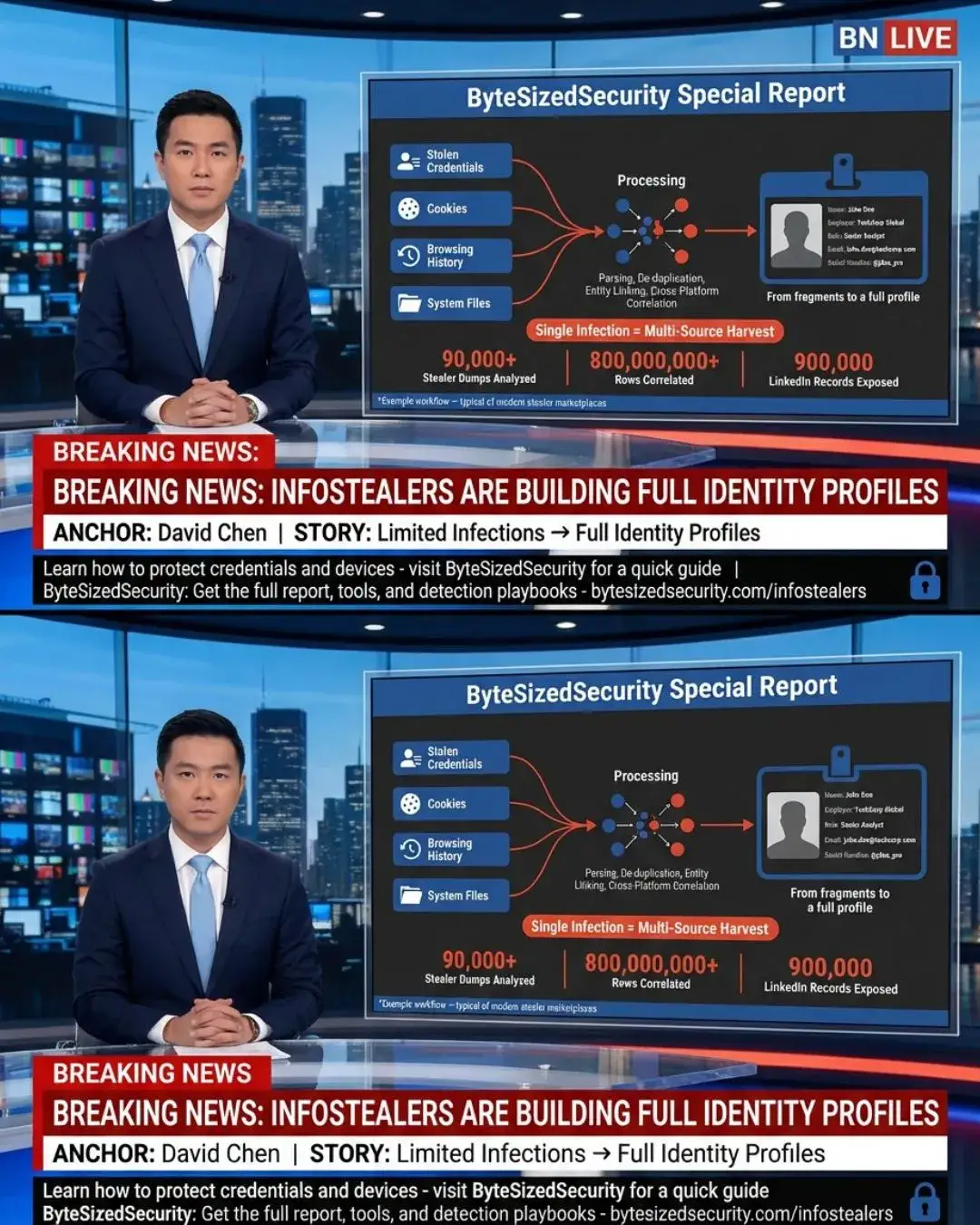
Title: How Infostealers Turn Stolen Credentials Into Real Identities
TL;DR: Infostealers now harvest far more than passwords. By collecting credentials, cookies, browsing history, and system files in a single infection, attackers piece together your real identity, your employer, your role, and your habits. Specops researchers analyzed 90,000+ infostealer dumps (800M+ rows of data) and found personal and professional boundaries collapse completely once this data is aggregated. Here’s how it works and what you should do about it.
Infostealers used to be simple. Grab a username and password, sell it, move on.
Those days are over.
Modern infostealers harvest everything on a compromised machine at once: stored credentials, browser cookies, active sessions, browsing history, and files sitting in user directories. The result isn’t a list of passwords. It’s a profile of a real person.
Specops researchers recently analyzed more than 90,000 leaked infostealer dumps containing over 800 million rows of data collected during active infections. What they found paints a clear picture of how a single compromised device turns into a full identity reconstruction.
From Credentials to Identity
The biggest shift in infostealer risk isn’t about the volume of stolen passwords. It’s about correlation.
A single dump often exposes reused account names across dozens of services, Windows usernames tied to an employer, files stored in user directories, active session tokens, and detailed browsing activity. Combined, these data points let an attacker connect a stolen credential to a real name, a real employer, and a specific role within an organization.
This collapses the wall between personal and professional identity most security models still rely on. A compromise starting on a personal laptop doesn’t stay personal for long.
What Services Are Being Exposed
The Specops dataset revealed credentials and session data across a wide spectrum of services.
Enterprise and Professional Platforms
LinkedIn, GitHub, Microsoft Teams, and Outlook appeared frequently. LinkedIn alone accounted for nearly 900,000 records in the dataset. For an attacker, it’s a direct line from a stolen credential dump to a real name, job title, and organizational affiliation.
This kind of information fuels targeted phishing and social engineering. When an attacker knows your name, your company, and your role, their emails get a lot more convincing.
Personal and Social Platforms
YouTube, Facebook, and other social media platforms showed up in high volume. These services often contain real names, photos, and social connections. For attackers, this makes it easy to validate who a compromised user is and cross-reference them with other stolen accounts.
Sensitive and High-Risk Services
The dataset also included credentials tied to government portals like the IRS and the Canada Revenue Agency, along with adult content platforms. Access to government services creates risks well beyond account takeover. Threat actors have a documented history of using adult platform data for extortion and blackmail. When this activity links back to a real identity and an employer, the stakes escalate fast.
Security-Aware Users Aren’t Immune
Domains like Shodan and even mil.gov appeared in the dumps. Being security-aware at work doesn’t mean your personal devices follow the same discipline. Attackers understand this gap and exploit it consistently.
Why Infostealers Keep Working
There’s no single point of failure here. Infostealers succeed because of a combination of common behaviors repeated at scale:
- Users install software from untrusted sources
- Passwords get reused across personal and corporate accounts
- Credentials and payment data sit in browser storage for convenience
Browser-stored credentials are especially valuable. When an infostealer lands on a machine, those credential stores give immediate access to high-value accounts without any additional effort from the attacker.
What Happens After the Theft
Once infostealer data has been collected and sold, prevention is no longer the only problem. The real question becomes: how fast do defenders neutralize exposed credentials before they get reused?
Infostealer dumps circulate for weeks or months before anyone detects them. During this window, attackers test harvested credentials against corporate environments, cloud services, VPNs, and remote access systems. Password reuse makes this trivially effective, even when those passwords meet standard complexity requirements.
What You Should Do
Whether you’re protecting yourself or your organization, the approach is the same: assume exposure and act accordingly.
For individuals:
- Stop reusing passwords across services. Period.
- Use a dedicated password manager instead of browser-based credential storage
- Enable two-factor authentication on every account that supports it
- Treat personal device security with the same discipline as your work environment
- Rotate passwords on critical accounts regularly, not when prompted
For organizations:
- Implement continuous credential monitoring against known breach databases
- Don’t rely on password checks only at creation or reset time
- Enforce policies blocking previously compromised passwords from being set
- Educate employees: personal device compromise is an enterprise risk
- Support longer passphrases and continuous enforcement over static complexity rules
The Bottom Line
Infostealers have evolved from simple credential theft tools into identity reconstruction engines. A single infection on a personal device provides enough data to identify a person, map their employer and role, access their active sessions, and correlate their activity across dozens of services.
The boundary between personal and professional identity no longer exists once this data is in an attacker’s hands. Reducing password reuse and monitoring for exposed credentials are the most direct ways to break this chain. For a deeper look at how stolen credentials are weaponized in corporate environments, read our breakdown of credential theft as the new normal in cyber attacks.
Your corporate perimeter doesn’t end at your office network. It extends to every personal device where an employee has ever logged into a work account.
Source: BleepingComputer - How infostealers turn stolen credentials into real identities https://www.bleepingcomputer.com/news/security/how-infostealers-turn-stolen-credentials-into-real-identities/